
Interior design with Chinese antique furniture: how to integrate, combine and showcase it
Un meuble chinois ancien n’est pas fait pour être exposé sous vitrine. Il gagne à être used, lived with and set off in a living room. Une armoire de mariage Shanxi peut structurer un salon contemporain aussi bien qu’un cabinet Qing dans une entrée. Voici comment intégrer une pièce d’antiquité asiatique dans une décoration moderne, avec l’œil d’un collectionneur qui a accompagné des dizaines de clients dans cette démarche.
Rule number one: one strong piece, not an accumulation
The first mistake amateurs make is wanting to wanting to gather several Asian pieces in the same room. A Chinesesame room. A Chinese wardrobe + a Tibetan chest + a Japanese lamp + a screen + prints: the result tips into exotic bric-a-brac and loses all emotion.
The rule of the seasoned collector: collector: one strong piece per living room. Un grand meuble asiatique dans un salon minimaliste raconte une histoire. Le même meuble dans un salon déjà chargé se noie et perd tout impact visuel. L’antiquité asiatique a besoin d’espace et de calme autour d’elle.
It is perfectly possible to have several Asian pieces in the house, provided they are spread out: an important piece in the sitting room, a more modest object in the bedroom, a sculpture in the entrance. Each piece thus keeps its presence.
Sitting room: the pieces that structure
The sitting room is where Chinese antique furniture has its strongest effect. Three proven options:
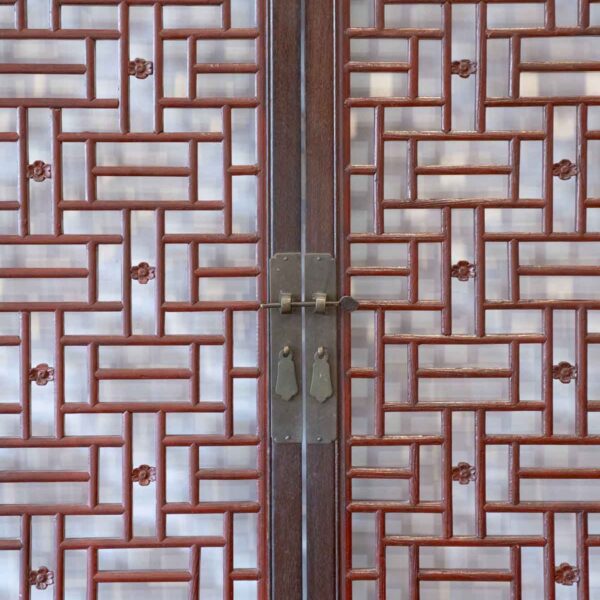
L’armoire de mariage Shanxi comme meuble d’appui : hauteur 190 à 220 cm, portes rouges laquées, ferrures en fer forgé. Placée contre un mur en tapisserie unie ou en pierre naturelle, elle devient le point focal de la pièce sans compétition. Elle sert de rangement discret pour la vaisselle de service, les bougies, les nappes, le linge de table.
The four-door Qing cabinet as a comme meuble de bibliothèque : bois d’orme ou de cyprès, patine profonde, laque foncée. Il abrite livres, objets d’art, alcools. Il s’associe particulièrement bien avec un mur peint dans un beige minéral ou un vert d’eau très pâle.
La table basse en huanghuali ou en orme comme table centrale : ses lignes épurées et sa hauteur (35 à 45 cm) s’harmonisent avec les canapés contemporains. À entourer de tapis simples (jute, laine unie) pour la mettre en valeur sans concurrence.
Entrance: the welcoming piece
L’entrée est un lieu idéal pour un place for a small Asian piece strong in character. One. On y passe rapidement mais on la voit chaque jour. Trois options :
Le coffre plat : a low piece of 90 to 130 cm, often in red cypress, with substantial fittings. Serves as a bench for removing shoes and as storage for shoes and scarves. Immediate effect, minimal upkeep.
The narrow two-door cabinet: height : hauteur 130 à 160 cm, largeur 60 à 80 cm. Occupe peu de mur mais donne du caractère à l’entrée. Il abrite les clés, les gants, les petits objets du quotidien.
A simple painted stand : a small painted tripod or low stool, supporting a vase, a plant or a sculpture. A minimalist solution for a small entrance.
Bedroom: calm and texture
In the bedroom, prefer more discreet, more quieter, more textured, less chromatically strong. Un cabinet à ferrures oxydées, un coffre peint aux couleurs adoucies par le temps, une table basse pour lire au coin d’une fenêtre.
Le painted Tibetan chest A painted Tibetan chest at the foot of the bed is a very strong choice: it serves as a bench for clothes, as storage for seasonal linen, and brings colour without overloading. Avoid it in a bedroom already rich in textures.
Le chevet chinois (a small two-drawer cabinet, height 55 to 70 cm) elegantly replaces an ordinary bedside table. It brings material, patina, and is genuinely useful.
Study and reading: function and emotion
The study and the reading corner are spaces where one spends hours: an antique piece finds a daily use there that brings it back to life.
Le Chinese scholar’s desk (« scholar’s table ») est une pièce recherchée : petite table étroite en huanghuali ou en zitan, souvent avec un tiroir central. Placée face à la fenêtre, elle devient un lieu d’écriture et de contemplation.
Le fauteuil Ming (« horseshoe chair »), avec ses lignes courbes et sa structure épurée, s’associe magnifiquement à un fauteuil design contemporain (Wegner, Nakashima). Le dialogue entre modernité scandinave et tradition asiatique est particulièrement heureux.
What to pair it with?
Chinese antique furniture pairs particularly well with:
- Raw natural materials: linen, : lin, coton, laine, jute, pierre naturelle, béton ciré, chêne brut
- Couleurs terreuses : blanc cassé, beige sable, gris pierre, vert eucalyptus, terracotta doux
- Design nordique contemporain : Wegner, Juhl, Aalto, Nakashima
- Art contemporain minimaliste : monochromes, photographie noir et blanc, dessins encre
- Végétal : bambou, monstera, ficus, olivier en pot
Avoid: “chinoiserie” decorations (modern decorative screens, red lanterns, printed calligraphies), which tip the atmosphere into pastiche and crush the quality of the antique piece.
Lighting: setting off the patinas
A poorly lit antique piece loses half its interest. Deep patinas, oxidised fittings, painted decoration only reveal themselves with raking light.
Two proven options:
Warm indirect lighting (2700 K, CRI 90+): a wall light above the piece, aimed downward, about 60 cm above. It highlights relief without crushing the colours.
Lampe d’appoint posée sur le meuble : lampe céramique unie (blanche, écrue), abat-jour en lin brut. Crée un halo chaleureux qui invite à s’approcher du meuble. Solution particulièrement adaptée aux cabinets et coffres bas.
Absolutely avoid: direct spotlights with cold light (>4000 K), which flatten patinas and give a “museum showcase” look. Warm, soft light is always preferable for antiques.
Day-to-day care
A Chinese antique piece properly cared for can cross several generations without heavy intervention. The simple rules:
- Dépoussiérage hebdomadaire au chiffon en microfibre sec ou légèrement humidifié à l’eau claire
- Avoid chemical products : no Pledge, no silicone, no industrial wax. Modern compounds attack old varnishes and lacquers.
- Cire d’abeille naturelle once or twice a year, applied in a very thin coat then buffed
- Hygrométrie contrôlée : ideally 45 to 55%. Too dry (central heating) and the wood splits. Too damp (cellar) and it swells. A simple humidifier in heated rooms is enough.
- Pas d’exposition directe au soleil lacquers and painted decoration fade within a few years under direct sunlight.
- Avoid heavy damp objects objects placed on the piece without a wooden or fabric mat
Choosing the first piece
For a first purchase, two practical tips:
Take a functional piece. A piecepiece. A piece that truly serves (storage, table, bench) will find its place naturally. A purely decorative piece risks becoming clutter.
Choose a piece you truly love, not a piece “for, pas une pièce « à valeur d’investissement ». Le mobilier chinois ancien est un choix de vie, pas un placement. Une pièce qui vous parle esthétiquement vous accompagnera vingt ans sans lassitude.
Galerie 55 accompagne ses clients dans le choix de leur première pièce ou l’agrandissement de leur collection. Contact us to visit the gallery at the Marché Biron or for personalised advice for your interior.
Voir aussi : Les meubles du Shanxi et Estimation d’un meuble chinois ancien.
Sur le même sujet
Estimation d’un meuble chinois ancien : comment évaluer la valeur d’une pièce
Combien vaut réellement un meuble chinois ancien en 2026 ? Les critères d'estimation utilisés par les experts : essence de bois, période,…
Antique Tibetan chests and cabinets: history, styles and signs of authenticity
Coffres peints, cabinets d'autel, tables basses : le mobilier tibétain ancien fascine par ses couleurs, ses symboles religieux et son histoire. Guide…
 Buying guide
Where to find Chinese antique furniture in Paris: Galerie 55 at the Marché Biron
Paris est l’une des grandes capitales mondiales de l’antiquité asiatique, aux côtés de Londres, Hong Kong et New York. Pour qui sait…
Explorez la collection
Retrouvez notre sélection d'antiquités asiatiques : mobilier chinois, paravents, objets d'autel, coups de cœur venus d'ailleurs.
Voir la collection →