
Antique Tibetan chests and cabinets: history, styles and signs of authenticity
Le tables: antique Tibetan furniture fascinates occupe une place à part dans le monde de l’antiquité asiatique. Coffres peints aux couleurs vives, cabinets d’autel rehaussés d’or, petites tables basses au plateau laqué : chaque pièce raconte l’histoire d’un plateau himalayen isolé, où l’art religieux bouddhique s’est fondu avec les traditions décoratives locales.
The history of Tibetan furniture
Antique furniture from Tibet is largely religious or linked to the bourgeois house. It developed mainly from the 17th century onward, with the influence of Vajrayana bouddhisme vajrayana et l’essor des grands monastères de Lhassa, Shigatsé et Gyantsé. Les pièces les plus recherchées datent du XVIIIe et du XIXe siècle, avec un pic de production sous le règne du 13e Dalaï-Lama (1876 à 1933).
Three decorative traditions stand out: the Lhasa style, style de Lhassa, plus raffiné, avec des motifs proches de l’art de la Chine des Qing ; le style de l’est du Tibet (Kham and Amdo), more expressive, with brighter colours; and the monastic style, style monastiquehighly codified, reserved for temples and the residences of lamas.
Painted Tibetan chests
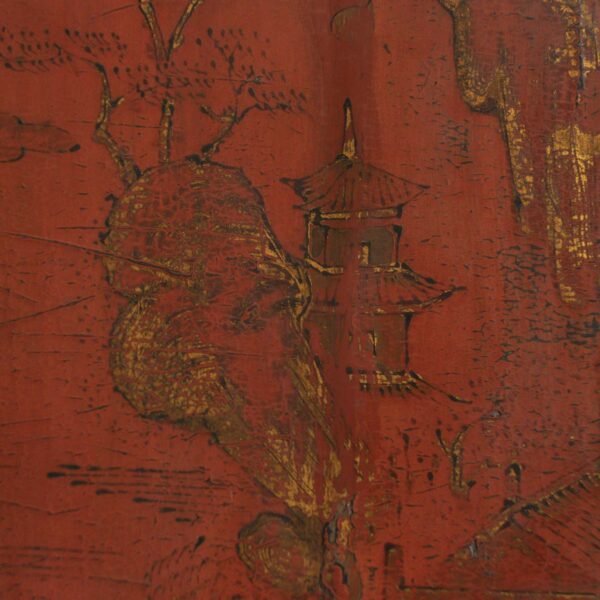
Le painted Tibetan chest The painted Tibetan chest is the emblematic piece. Rectangular in form, it was used to store clothes, precious textiles and ritual objects. Its outer panels almost always show painted decoration on a red, black or yellow ground, with Buddhist scenes (buddhas, protectors, sacred animals), stylised floral motifs (lotus flowers, peonies) or adopted Chinese symbols (dragons, phoenixes, bats).
The eight auspicious symbols of Buddhism (ashtamangala) reviennent fréquemment : parasol, poisson d’or, vase précieux, fleur de lotus, conque, nœud sans fin, drapeau de victoire, roue du dharma. Un coffre authentique du XIXe présente un décor peint à la main, avec des variations et des hésitations de tracé absentes des copies récentes.
Altar cabinets
Les cabinets d’autel (chöksham) servaient à abriter les statues bouddhiques, les livres sacrés et les instruments rituels. Ils prennent la forme d’un meuble haut à deux ou trois niveaux, avec des portes centrales flanquées de niches ouvertes.
The decoration is particularly carefully worked: leaf gilding, inlaid turquoise or coral cabochons, polychrome panels representing mandalas or Buddhist paradises. These pieces, reserved for important monasteries and wealthy families, are today the most sought-after and the rarest on the market.
Iconography and reading the motifs
Understanding the iconography of a Tibetan piece helps both to authenticate it and to appreciate its character. The most common motifs:
- Snow lion (snow lion): guardian of Tibet, symbol of royal power
- Dragon (druk) : symbol of power, often paired with the phoenix
- Roue du Dharma : représentation de l’enseignement du Bouddha
- Endless knot Endless knot: interdependence of all phenomena
- Lotus : purity and awakening
- Vajra et cloche : instruments rituels tantriques
The colours themselves carry meaning: red symbolises power and protection, blue celestial wisdom, yellow wealth and royalty, green harmony with nature. An antique Tibetan piece almost always shows a meaningful combination of these colours.
Signs of authenticity
The market for Tibetan furniture is flooded with copies made in Nepal, India or Sichuan China since the 1990s. Signs of an authentic antique piece:
- Paint based on natural mineral pigments (malachite for green, cinnabar for red, azurite for blue), with slight chromatic ageing
- Solid fine-grained wood (often Himalayan pine or birch), with traces of natural wear on edges and handling zones
- Visible mortise-and-tenon joinery, without modern screws or synthetic glues
- Hinges and fittings in oxidised wrought iron, with a deep patina
- Hand decoration with micro-imperfections, runs and retouches, absent from an industrial copy
Market and price ranges
Prices in 2026 for antique Tibetan furniture vary considerably according to quality, period and condition. A small ordinary painted 19th-century chest typically changes hands between €800 and €3,000, a fine chest with rich decoration between €3,000 and €10,000, a monastic altar cabinet between €8,000 and €30,000. Exceptional pieces with documented provenance can exceed €50,000 at public auction.
The question of lawful provenance est essentielle : depuis les années 2010, l’exportation d’antiquités hors du Tibet est encadrée. Une pièce entrée en Europe avant 1980 (avec factures ou documents d’importation d’époque) reste parfaitement commercialisable. Les acquisitions plus récentes nécessitent des documents douaniers en règle.
Chez Galerie 55Galerie 55, every Tibetan piece is selected for its authenticity, its state of conservation and its decorative quality Contact us pour une estimation, un conseil d’achat ou pour découvrir notre sélection de coffres et cabinets tibétains anciens.
Sur le même sujet
 Buying guide
Chinese antique furniture: how to recognise an authentic piece
The market for Chinese antique furniture is fascinating — and also full of recent reproductions sold as antiques…
Estimation d’un meuble chinois ancien : comment évaluer la valeur d’une pièce
Combien vaut réellement un meuble chinois ancien en 2026 ? Les critères d'estimation utilisés par les experts : essence de bois, période,…
Interior design with Chinese antique furniture: how to integrate, combine and showcase it
Salon, entrée, chambre, bureau : comment intégrer un meuble chinois ancien dans un intérieur contemporain. Associations de couleurs et matières, éclairage, entretien…
Explorez la collection
Retrouvez notre sélection d'antiquités asiatiques : mobilier chinois, paravents, objets d'autel, coups de cœur venus d'ailleurs.
Voir la collection →