
Chinese antique furniture: how to recognise an authentic piece
Le marché du mobilier chinois ancien est passionnant, mais il est aussi peuplé de reproductions récentes vendues comme antiquités. En trente ans d’exercice de Teck Home, la Galerie Cristo à la Galerie 55, nous avons vu passer des milliers de pièces : les vraies, les copies, les hybrides, les restaurations excessives, les fausses patines savamment appliquées. L’œil s’affûte, la main reconnaît, et surtout, on apprend à ne pas se fier à une seule intuition.
Here, in this long-form guide, are the seven main criteria que nous appliquons pour authentifier un meuble asiatique ancien, avec des exemples concrets, des ordres de grandeur de prix, et les pièges les plus fréquents. C’est aussi la grille de lecture que vous pouvez utiliser vous-même avant d’acheter, que ce soit aux Puces de Saint-Ouen, chez un antiquaire, aux enchères ou sur une plateforme en ligne.
Why so many reproductions on the market?
Since the 1990s, the Chinese furniture industry has understood the value of the Western market for antiques. Whole workshops, especially in southern China (Guangdong, Fujian), produce artificially aged furniture: wood scorched with a blowtorch to simulate patina, lacquers tinted with wax to imitate Ming varnish, gilded fittings then aged with acid. These reproductions arrive in Europe by the container-load, distributed through importers, then resold as antiques by unscrupulous or poorly informed sellers.
The difficulty is that these reproductions are sometimes excellentes. Elles trompent les acheteurs pressés, les décorateurs peu spécialisés, et même certains antiquaires généralistes. C’est pourquoi les sept critères ci-dessous doivent être vérifiés en combinaison : none is enough on its own.
1. The wood and its patina
The first thing to observe is the the materialis the material. Chinese antique furniture is mainly made in elm orme (yumu), en cyprès, en pin ou en bois de rose rosewood (huanghuali, zitan) for imperial pieces. An antique piece shows a deep, irregular patina, with darker zones where hands have touched the wood for generations (handles, corners, table tops).
Une patine trop uniforme, brillante ou cirée est souvent le signe d’un traitement récent : cire teintée, huile abrasive ou vernis synthétique. La vraie patine est vivante : elle change selon l’exposition à la lumière, réagit à la température, se laisse toucher. Sur un buffet vieux de 150 ans, vous verrez que les zones les plus sombres correspondent aux endroits que les mains ont naturellement effleurés : boutons, poignées, angles supérieurs des tiroirs. C’est ce qu’on appelle l’usure d’usage.
Conversely, a patina “made” in the workshop leaves marks that are too regular: blowtorch marks visible against the light, uniform application, no contrast between zones. Artificially scorched wood also leaves a slightly acrid smell, different from the soft, woody smell of old elm.
A simple visual test
Look at the piece against the light, under raking light. On an authentic piece you will see micro-scratches, marks of old tools (blades not perfectly sharpened), zones deeper than others. On a reproduction the surface is strangely flat, without “lived-in” character.
2. Traditional joinery
Les artisans chinois maîtrisent depuis mille ans l’art de l’assemblage sans clou ni viswithout nail or screw. An authentic antique piece comes apart through a play of precisely fitted tenons and mortises. Over time these joints leave a slight play, discreet cracking, sometimes a small chip at the junctions — all marks of time.
Vérifiez sous le plateau ou à l’intérieur d’un tiroir : la présence de vis modernes, d’agrafes ou d’équerres métalliques est un signal d’alerte immédiat. Une antiquité authentique n’utilise pas de quincaillerie industrielle. Les assemblages traditionnels chinois portent des noms précis : gu ding (tenon « chapeau »), zhi kou (queue d’aronde chinoise), chuo jiao (assemblage « à mâchoires »). Un antiquaire spécialisé sait les identifier au premier coup d’œil.
Ce qu’il faut chercher
- Drawer bottoms assembled with dovetails or tongue-and-groove (never stapled)
- Removable legs via a square tenon with a wooden peg
- Floating panels in a frame (never glued or nailed fixed)
- Marks of old tools on interior surfaces: gouge cuts, plane marks, hatchings
3. Lacquer and its craquelure
La laque chinoise traditionnelle est obtenue à partir de la sève d’un arbre, le Rhus vernicifluaverniciflua. Applied in dozens of layers, it takes months to dry. On antique furniture it naturally shows fine craquelure, craquelures fines, appelées « peau de crocodile » : c’est un défaut recherché des collectionneurs, garant de l’authenticité.
A uniform lacquer with no craquelure at all is almost always modern. Nineteenth-century polychromee polychrome lacquers are sometimes retouched: look for differences in tone, micro-losses, nuances that betray the human hand.
Typical colours and their region of origin
Each major Chinese region developed a coloured signature. Deep oxblood red is characteristic of Shanxi. Brighter orange-red ShanxiBrighter orange-red comes rather from Zhejiang. Dark black ZhejiangDark black lacquers, often heightened with gilding, are typical of Sichuan and Fujian Sichuan et du FujianPolychromes with court scenes, in green, ochre and gold, are associated with Ningbo and Ningbo Ningbo and the coastal province of Guangdong.
This regional diversity is a precious tool: if a seller offers you a “Shanxi wardrobe” with an orange lacquer typical of Zhejiang, there is an inconsistency to dig into.
4. Period fittings
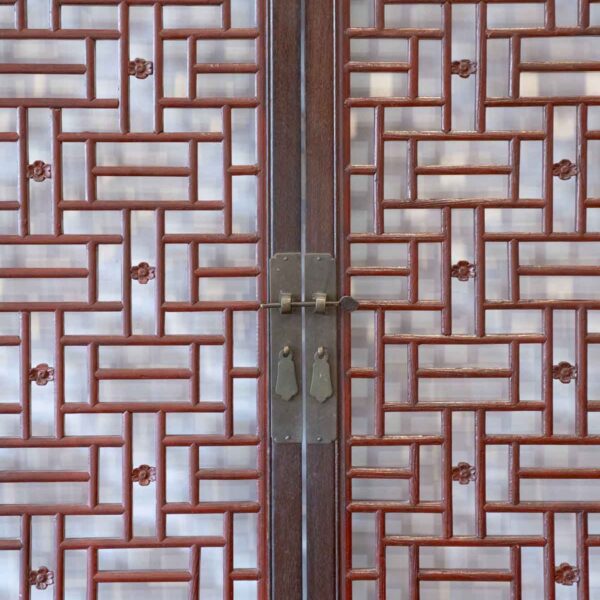
Handles, lock plates and decorative nails on Chinese antique furniture are in brass, laiton, cuivre ou fer forgé. Elles présentent des marques d’usage : dépôts d’oxydation, patine verdâtre, angles usés par le temps. Une ferrure trop brillante, dorée, ou d’une forme moderne est presque toujours ajoutée récemment.
Also look at the fixing: on an antique piece the fitting is bolted in the old way (a pin through the wood, a forged nail with an irregular flat head), not screwed with a Phillips screwdriver. The round brass fittings of Shanxi, with their double motif of concentric circles, are particularly recognisable.
The trap of “aged” fittings
A classic trick: replace the original fittings with acid-aged copies. The “authentic” fitting you touch is in fact a piece made last year, plunged in a chemical bath to give it the look of oxidised brass. How to detect the deception? By looking at the back — the face that touches the wood. A truly old fitting will have, on the reverse, a lighter patina, discoloured by decades of contact with the wood. A recent copy will be uniformly greened on both faces.
5. Chinese dimensions
Chinese antique furniture has particular proportions: tops often low (the Chinese sat on mats or low chairs), limited depths, sideboards wider than they are deep. A piece with Western dimensions (standard European height, generous depth) is probably a modern adaptation or a reproduction aimed at the Western market.
Traditional Chinese occasional tables are 40 to 50 cm high, against 55 to 60 cm for ours. Low sideboards typically stand 80 to 90 cm high, against 100 to 110 cm in Europe. Wardrobes are tall (1.80 to 2 m), narrow, often deeper than a French wardrobe: up to 60 cm deep, because they held large Chinese cotton jackets folded flat.
6. La provenance et l’histoire
A serious antique dealer will tell you where where and when where and when they acquired the piece: city, region.
The right question to ask: “which province does this piece come from?”
A good certificate of authenticity mentions:
- Dating as precise as possible (century, possibly decade or dynasty)
- La province d’origine
- The main material and, where relevant, the type of lacquer
- Any restorations
7. Price: neither too low nor too high
Un buffet chinois ancien authentique en orme se négocie entre 1 500 et 4 000 € selon la région, l’état et les décors. Une armoire de mariage laquée rouge oscille entre 2 000 et 5 000 €. Un paravent à six feuilles peut atteindre 3 000 à 8 000 €.
A piece presented for under €800 as a 19th-century Chinese antiquee est presque toujours une reproduction. À l’inverse, un prix stratosphérique sans provenance vérifiable est suspect : les vraies pièces impériales (huanghuali, cour Ming) atteignent des sommets mais sont accompagnées d’une documentation solide, d’expertises signées, et se vendent principalement dans les grandes maisons d’enchères.
A realistic 2026 range by category
- Small cabinet or low table: €800 to €1,800
- Buffet XXe en orme : 1 500 à 3 500 €
- Red-lacquered wedding wardrobe: €2,000 to €5,000
- Wedding chest: €1,000 to €2,500
- Gilded offering cabinet: €2,500 to €5,000
- Six-leaf lacquered screen: €3,000 to €8,000
- Elm day bed: €3,000 to €6,000
- Large screen with full-period Qing decoration: €5,000 to €15,000
At Galerie 55, what we guarantee
Every piece shown at Galerie 55, Galerie 55, at the Marché Biron, est :
- Personally sourced by Patricia Ederhy
- Dated (century, possibly decade)
- Documented as to its provenance (region, craftsmanship, and where possible the history of the house it came from)
- Restored with discretion, solely to preserve the material (never a full re-lacquering)
We welcome you by appointment in Saint-Ouen to talk, examine and compare. It is one of the great pleasures of the trade: sharing these criteria and watching your eye sharpen over successive visits. Take your time, bring a torch, turn the piece over, open every drawer. A good antique dealer loves curious buyers.
Frequently asked questions
How does one date a Chinese piece precisely?
Il n’existe pas de méthode absolue. La datation combine plusieurs indices : style (Ming, Qing, République), matière, patine, ferrures, éventuelles marques ou inscriptions. Pour les pièces impériales, des expertises scientifiques (datation du bois par dendrochronologie, analyse de la laque) sont possibles mais coûteuses. Pour un meuble d’usage, on parle en général de fourchette : « seconde moitié du XIXe the 19th century” is more honest than “1875”.
Should restored pieces be avoided?
No, provided the restorations are limited, reversible and documented. Consolidating tenons, gentle cleaning, replacing a broken peg are normal and acceptable. A full re-lacquering, a change of fittings, a general stripping are interventions that degrade historical value.
Will a Chinese antique piece hold up in a modern interior?
Absolutely. Chinese antique furniture is made to last for centuries. It lives very well in a heated interior, provided one avoids direct proximity to radiators (which dry the wood) and permanent full sun (which alters the lacquer). A hygrometer at 40–60% humidity is ideal.
Can one use a Chinese antique sideboard as a TV unit?
Yes — it is even one of the most frequent uses. The long low Shanxi sideboards, in red lacquer, make spectacular TV stands, provided one ensures ventilation for the electronics (do not block the vents).
Conclusion : la meilleure garantie, c’est le contact humain
Aucun de ces sept critères pris isolément ne suffit à authentifier une pièce. C’est leur convergence qui fait l’antiquité véritable : une patine profonde et traditional joinery et des ferrures d’époque et clear provenance. In case of doubt, always prefer an established antique dealer, who puts their signature on the piece, to an anonymous online platform.
Chinese antique furniture is one of the most fascinating fields in world antiques. Every piece tells a story: that of a Shanxi merchant family, a Suzhou scholar, a Sichuan temple. Taking the time to choose is also taking the time to enter that story.
Discover our selection of Chinese antique furniture ou prenez rendez-vous or book an appointment to see the pieces at the gallery, at the heart of the Marché Biron. guide de l’histoire du mobilier chinois et notre guide d’achat à Paris.
Sur le même sujet
 Buying guide
Where to find Chinese antique furniture in Paris: Galerie 55 at the Marché Biron
Paris est l’une des grandes capitales mondiales de l’antiquité asiatique, aux côtés de Londres, Hong Kong et New York. Pour qui sait…
Marché Biron in Paris Saint-Ouen: a guide to Asian antiques
Marché Biron, l'un des plus prestigieux du monde pour l'antiquité, concentre à Saint-Ouen une densité unique de spécialistes de l'art asiatique. Guide…
Antique Tibetan chests and cabinets: history, styles and signs of authenticity
Coffres peints, cabinets d'autel, tables basses : le mobilier tibétain ancien fascine par ses couleurs, ses symboles religieux et son histoire. Guide…
Explorez la collection
Retrouvez notre sélection d'antiquités asiatiques : mobilier chinois, paravents, objets d'autel, coups de cœur venus d'ailleurs.
Voir la collection →